
A practical guide for the Microsoft Azure Fundamentals exam and for anyone moving workloads to the cloud.
Introduction
In an organization, when you run software on your own servers (data centers), you own everything: the building, the power, the network cables, the operating system, the application, and the data.
Now, when you move to the cloud, some of that burden shifts to the provider, but not all of it.
The shared responsibility model defines exactly where the provider’s job ends and yours begins, and it is one of the most reliably tested topics in the AZ-900 exam.
What is the Shared Responsibility Model?
This framework, the “Shared Responsibility Model,” divides security and operational duties between the cloud provider (Microsoft Azure in our case) and the customer.
The key idea is simple:
“The provider is responsible of the cloud. The customer is responsible in the cloud”
Microsoft secures the underlying infrastructure that makes Azure run.
You secure what you put on it and how you configure it; the exact split depends on the type of cloud service you use.
Why It Matters?
In reality, most real-world cloud security incidents are not caused by breaches of the provider’s data centers.
The real reason: customer-side mistakes.
For example: a storage account left open to the public, weak credentials, an unpatched virtual machine, or overly broad permissions.
Believing that “the cloud is secured by default” is the most common and most costly misunderstanding.
Knowing your side of the line is the first step to staying safe.
The key takeaway is clarifying roles and responsibilities: overall, this model splits responsibilities between the customer and the provider.
The Determined Responsibilities
Some responsibilities never move, regardless of the service model.
Always the cloud provider’s responsibility:
- Physical data center (buildings, physical access control, power, cooling, and surveillance)
- Physical network (cabling, switches, and the connectivity between data centers)
- Physical hosts (the servers and hardware that run your workloads)
Always the customer’s responsibility:
- Information and data: classifying, protecting, and governing the data you store
- Devices (mobile and PCs): the endpoints your people use to reach cloud resources
- Accounts and identities: users, passwords, multi-factor authentication, and who has access to what
If you are still confused, think of it this way: Microsoft will never decide what is sensitive in your data, who your employees are, or what devices (laptops) they use, and you will never be asked to patch the firmware on an Azure host server.
The Responsibilities That Shift
Five areas change hands depending on whether you use on-premises, IaaS, PaaS, or SaaS.
Please look at the diagram below that illustrates the areas of responsibility between you and Microsoft.
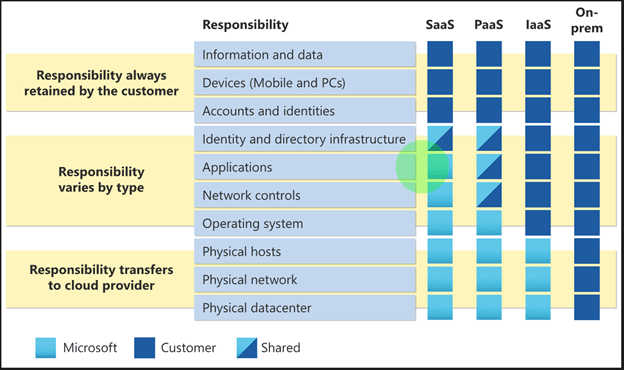
Image Source:
https://learn.microsoft.com/en-us/azure/security/fundamentals/shared-responsibility
Examples in Azure
IaaS
Azure Virtual Machines: Microsoft manages the physical host and the hypervisor. You manage the guest operating system (including patching and updates), applications, network configuration (such as network security groups), and your data.
PaaS
Azure App Service or Azure SQL Database: Microsoft also manages the operating system and runtime patching. Indeed, you are responsible for your application code, its configuration, access control, and your data. You no longer worry about OS updates, which is a major benefit of PaaS.
SaaS
Microsoft 365: Microsoft runs the application, the platform, and the infrastructure.
You are still responsible for your data, the accounts and identities of your users, and the devices they sign in from.
And enabling multi-factor authentication and setting sensible sharing policies are your job.
Summary
Depending on the type of service, the shared responsibility model divides responsibilities between the provider and the client.
Identities, devices, and data are always yours. In the cloud, Microsoft always controls the physical layer.
You never give up control over your data and access, but the more managed the service (SaaS over PaaS over IaaS), the less you have to maintain.
Understanding your side of the model is crucial for both the test and real-world work because customer-side misconfiguration is the primary cause of cloud breaches.
If you’re ready to go a step further, I’ve added a short video below that demonstrates the shared responsibility in the cloud:
https://www.tiktok.com/@jinazuredotnet/video/7658569259718626580


Leave a Reply